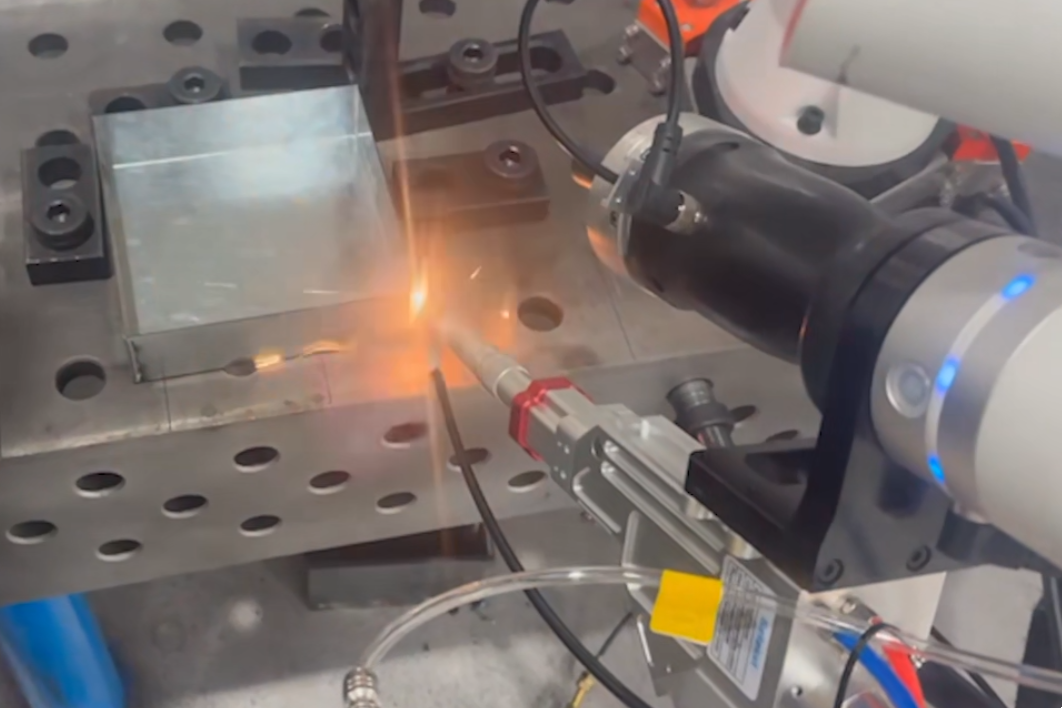
Collaborative Robot Laser Welding Demonstration for Thin-Plate Enclosures
Thin-plate enclosures are widely applied in fields such as 3C products, home appliances, and new energy. Traditional welding is prone to problems including burn-through, deformation and uneven weld seams. Collaborative robot laser welding features high flexibility, superior precision and low heat input, enabling efficient and stable welding of thin-plate workpieces.
This demonstration adopts a collaborative robot equipped with a fiber laser welding head to carry out automatic welding operations on galvanized steel thin-plate enclosures. With vision positioning and weld seam tracking technology, it realizes accurate identification of enclosure joints and path correction, eliminating deviations caused by manual teaching. Before welding, the workpiece undergoes surface cleaning and fixture positioning fixation to reduce assembly gaps and ensure welding stability.
Pulsed laser mode is adopted for welding, which precisely controls power, pulse width and welding speed. It achieves deep penetration welding with low heat input, effectively restraining burn-through, collapse and thermal deformation of thin plates, and guaranteeing the forming precision of enclosures. The flexible characteristics of collaborative robots can adapt to multi-angle weld seams of enclosures. Complex tooling is not required, and different workpieces can be quickly switched through simple teaching, realizing multi-variety and small-batch production. The arc and molten pool status are monitored in real time during the welding process, delivering uniform and aesthetic weld formation without secondary grinding. The entire process fully presents the full workflow of collaborative robot laser welding from positioning and welding to quality control, providing an automatic welding solution with high efficiency, low deformation and high consistency for thin-plate enclosures